· Investment Strategies · 3 sources · Updated
Dwelly’s $170M Series B: AI Roll-Up of UK Lettings with General Catalyst
EQT Growth led Dwelly’s $170M Series B ($95M equity + $75M Trinity debt) with General Catalyst — buy agencies, run them on an AI operating system.

Editorial team
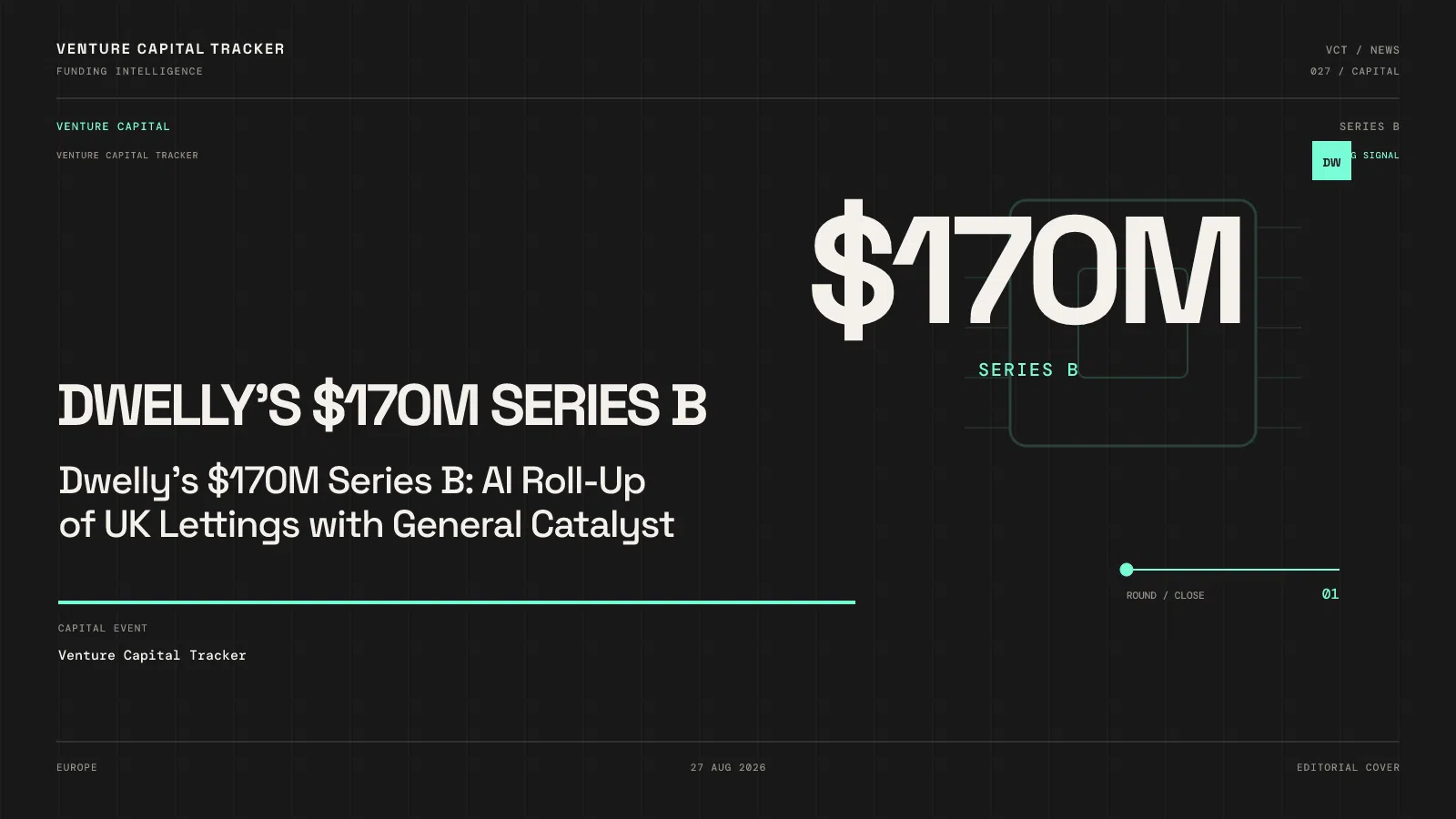
Dwelly raised a $170 million Series B announced July 28, 2026 — $95M equity led by EQT Growth with General Catalyst participating, plus a $75M Trinity Capital debt facility. The London company is not selling another property portal. It buys letting agencies and runs them on an AI operating system.
Deal details & investors
Funding event
Dwelly
Led by EQT Growth
(Still in the Aug 10–11 news tape — included as the proptech/AI-services gap-fill.)
Key facts
- Company
- Dwelly (London)
- Round
- $170M Series B ($95M equity + $75M Trinity debt)
- Date
- July 28, 2026
- Equity lead
- EQT Growth (GC co-lead per some press)
- Other equity
- General Catalyst, s16vc, Begin Capital, DVC, Philipp Freise, operator angels
- Prior
- $93M (Feb 2026)
- Scale
- 15,000+ properties; ~£350M rent roll; top-10 UK agency (company)
- Market context
- ~20,000 UK lettings firms; ~5.5M rental properties; >£100B rent / ~£10B commissions (company framing)
Who uses the product — and for what job
End customers: landlords and tenants who need maintenance, compliance, rent collection, and communication handled without inbox chaos.
Operators inside the system: agency staff who supervise AI agents and keep high-trust judgment calls (inspections, investment advice, exceptions).
Job: automate the transactional layer (docs, scheduling, contractor routing, routine Q&A) so each human agent can manage 300+ units vs ~100 historically (company target framing).
Why now
- UK Renters’ Rights Act and compliance load raised the cost of running small agencies.
- Sequoia’s “$1 software / $6 services” budget framing made AI-native services a legitimate venture category.
- Pure proptech SaaS struggles with agency adoption; owning the workflow via M&A removes the sell-in problem.
- Fragmentation (thousands of independents) is a classic roll-up surface once AI can actually do the work.
Why General Catalyst / EQT — portfolio fit
| Investor | Fit |
|---|---|
| General Catalyst | Comfortable with AI × real-world operations and transformation vehicles, not only seat-based SaaS |
| EQT Growth | European growth equity that understands services consolidation and operational KPIs |
| Trinity debt | Acquisition dry powder without over-diluting equity for every agency purchase |
Likely founder rationale: pair a European PE/growth lead that underwrites roll-ups with a U.S. multi-stage firm fluent in AI agents — then add debt so M&A velocity does not wait on the next equity round.
Competitive map
| Model | Lane |
|---|---|
| Traditional portals (Rightmove, etc.) | Demand aggregation; not agency OS |
| Vertical proptech SaaS | Sells software into agencies; adoption friction |
| Corporate property managers | Scale without AI-native cost structure |
| Pure AI inbox tools | Features without owning P&L of the service |
Dwelly’s claim: AI services > SaaS when you absorb labor budgets, not software budgets.
When not to underwrite this
- Wrong if you value it like a pure software company with 80%+ gross margins from day one — integration debt is real.
- Wrong if rent-roll growth is treated as recurring SaaS ARR.
- Wrong if you ignore local service-quality risk during rapid acquisitions.
Practical takeaway
- Founders (AI services): Own the P&L of the work you automate — Dwelly’s data advantage comes from acquired email histories, not public datasets.
- Investors: Diligence same-store margin expansion after AI migration, not just property count.
- Operators: Ask what stays human (trust layer) vs what is autonomously closed — that boundary is the product.
Follow Venture Capital Tracker on Google
Add VCT as a preferred source to see more of our venture-capital reporting in Google Search.
Last updated:
Editorial note: AI tools assisted with research, structure, or drafting. Venture Capital Tracker retains human editorial responsibility for factual accuracy, relevance, and source quality before publication.