Why Insight Partners Led Convex's $57M Series B for AI-Era Backends
Convex raised $57M Series B led by Insight Partners, with a16z and Spark returning — a bet that agent-written software needs a reliability layer Postgres never provided.
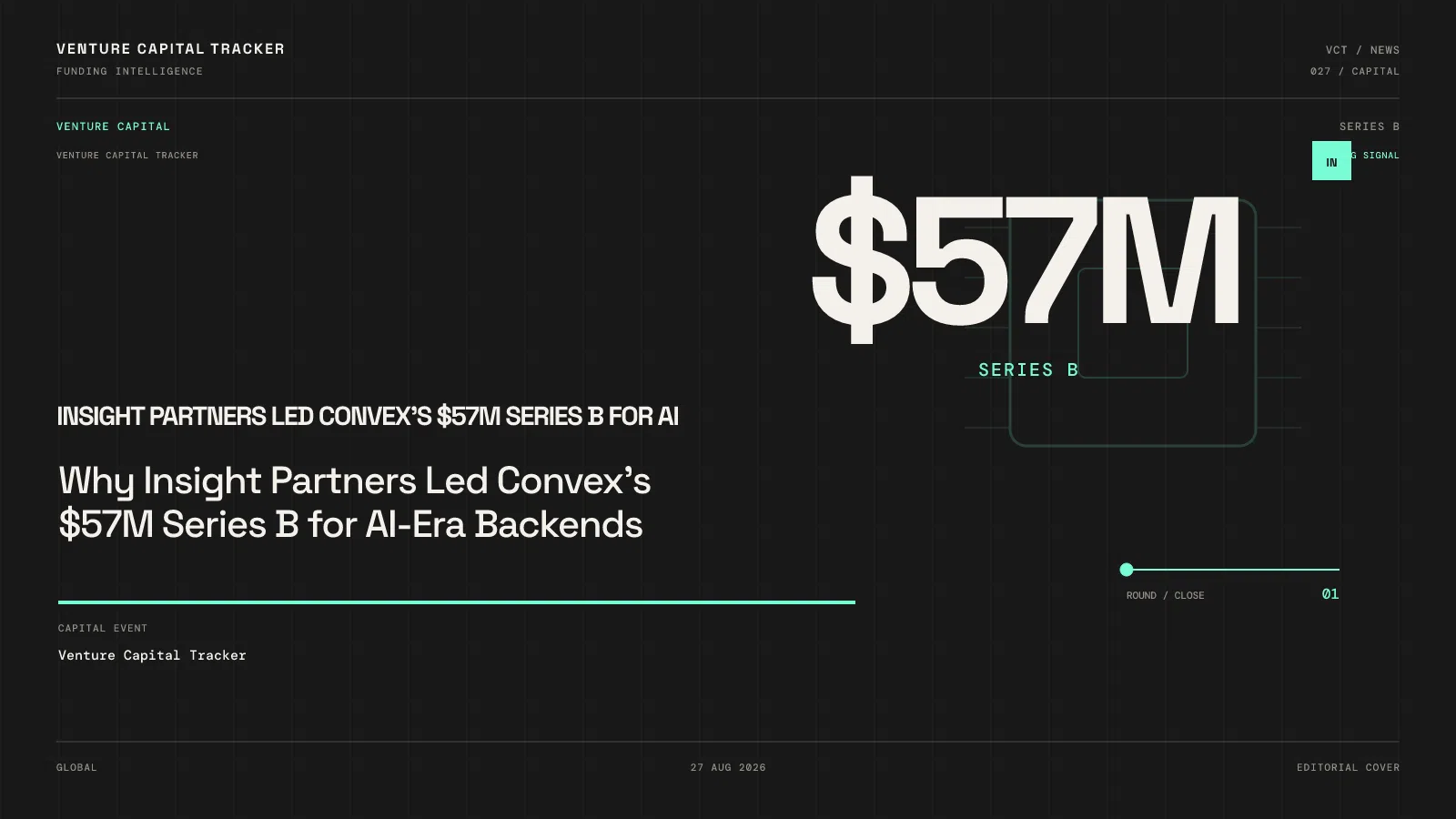
Convex closed a $57 million Series B on August 4, 2026, led by Insight Partners, with Andreessen Horowitz and Spark Capital returning. Total funding is now $110.5 million. The thesis is blunt: agents write code faster than humans can babysit databases.
Deal snapshot
| Field | Detail |
|---|---|
| Amount | $57M Series B |
| Lead | Insight Partners |
| Returning | a16z, Spark Capital (+ Justin Kan) |
| New | Etna Labs |
| HQ | San Francisco |
| Total raised | $110.5M |
Who uses the product — and for what
Convex sells a hosted reactive backend: TypeScript functions, a document-style database, and automatic client sync. Teams use it when they want multiplayer UX without stitching localStorage, IndexedDB, websockets, and optimistic updates by hand.
Named customer signal from the company includes Reducto, which cited Convex for collapsing state management into one consistent source of truth for both humans and agents. Convex also reports millions of production instances, live Enterprise plans, and EU hosting for residency-constrained buyers.
Why this is a live problem now
Eighteen months ago, buyers still asked "why not Postgres?" Agentic engineering flipped that objection. Developers (and agents) care less which database wins the beauty contest and more whether the system stays correct when code ships unread.
LLMs made code cheap. They made confidence expensive. Concurrent writes, hallucinated field names, and rotting glue code are the new production risk. Convex's pitch — ACID transactions, end-to-end TypeScript, automatic sync, sandboxed Components sized for an agent's context window — is a reliability bet on that shift.
Why raise from Insight (and keep a16z + Spark)
Insight Partners is a New York software scale-up shop: enterprise SaaS, data platforms, and AI-native B2B with operating support for GTM. Leading a Series B after Convex already has Enterprise traction fits Insight's playbook more cleanly than a seed microfund would.
a16z and Spark already underwrote Convex's prior growth capital. Follow-on here is portfolio continuity: developer infrastructure that compounds as coding agents become the primary writers of application code. Justin Kan's participation adds founder-operator signal without changing the institutional story.
Likely reasons Convex chose this syndicate:
- Growth equity muscle for enterprise GTM (Insight Onsite-style help).
- Category narrative — a16z can frame "backend for agents" next to its broader AI platform bets.
- Existing relationship cost — returning Spark/a16z lowers process risk vs. a full re-trade with strangers.
Competitive map
| Player | Angle |
|---|---|
| Firebase / Supabase | Familiar DX; less agent-isolation story |
| PlanetScale / Neon | Postgres excellence; different abstraction |
| Convex | Reactive TypeScript + component sandbox for agents |
| Custom on AWS/GCP | Control, higher ops burden |
When this thesis fails
- Enterprises standardize on Postgres + agents that already "know" it.
- Hyperscalers ship agent-safe backends that crush independent pricing.
- Convex's proprietary engine becomes a migration liability at Series D diligence.
Practical takeaway
Founders: If your product is "infra for AI-written software," lead with reliability guarantees and enterprise residency — not vibe-coding slogans. Investors: Watch ARR quality on Enterprise plans and whether Components become the unit of agent orchestration. Profile: /startup/convex.
Sources
- Convex company announcement: https://news.convex.dev/convex-raises-57m/
- PR Newswire: https://www.prnewswire.com/news-releases/convex-raises-57m-series-b-led-by-insight-partners-to-scale-the-reliable-backend-for-the-ai-era-302841686.html
- citybiz: https://www.citybiz.co/article/884042/convex-raises-57-million-series-b-to-expand-ai-native-backend-platform/
Follow Venture Capital Tracker in Google
Add VCT as a preferred source to make our venture-capital coverage easier to find in Google Search.
Editorial note: AI tools assisted with research, structure, or drafting. Venture Capital Tracker retains human editorial responsibility for factual accuracy, relevance, and source quality before publication.