· Venture Capital Tracker Editorial · investment-strategies
AIUC’s $40M Series A: Ribbit Bets on AI Agent Audits + Insurance
Artificial Intelligence Underwriting Company raised a $40 million Series A led by Ribbit Capital on September 15, 2026 — $55 million total. Product: AIUC-1 certification plus insurance up to $50M per policy. Named customers include Cursor, Harvey, Lovable, ElevenLabs.
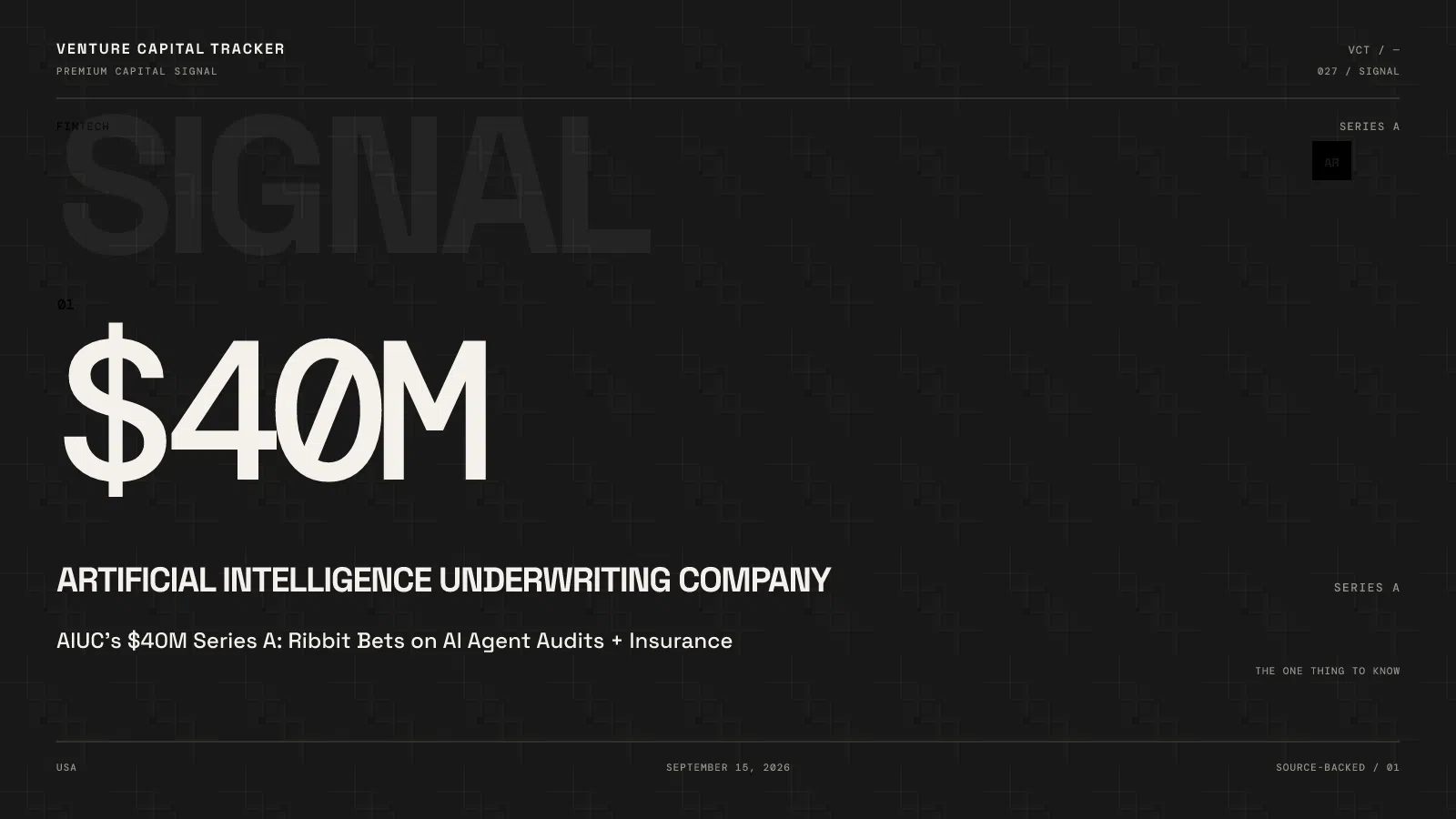
AIUC (Artificial Intelligence Underwriting Company) raised a $40 million Series A on September 15, 2026, led by Ribbit Capital, with First Harmonic participating. Total funding is $55 million after a $15 million seed from NFDG (Nat Friedman), Emergence, Terrain, and Anthropic co-founder Ben Mann among others. Valuation was not disclosed. Named customers in TechCrunch coverage: Cursor, Lovable, Harvey, and ElevenLabs (TechCrunch, FinSMEs).
Enterprises already believe models are smart enough — they refuse to deploy because nobody will guarantee behavior. AIUC is selling the SOC 2 playbook for agents: audit, certify, then insure.
Key facts
| Field | Detail |
|---|---|
| Company | AIUC (aiuc.com) — AI agent standards, audits, insurance |
| Financing | $40M Series A; $55M total |
| Date | September 15, 2026 |
| Lead | Ribbit Capital |
| Founders | Rune Kvist (early Anthropic); Rajiv Dattani (ex-METR COO) |
| Standard | AIUC-1 — ~5,000 adversarial tests; ~100-page reports (TC) |
| Insurance | Up to $50M losses per policy (company product page) |
| Valuation / ARR | Not disclosed |
Who uses the product — and for what job
Users: (1) AI product companies that sell agents into enterprises and need a third-party trust layer; (2) enterprise buyers (banks, hospitals, governments) that need evidence before deployment.
Job: run independent audits against jailbreaks, prompt injection, hallucinations, data leaks, and unsafe tool use; issue AIUC-1 certification with quarterly recertification; unlock insurance that covers AI-specific failure modes so vendors can contractually protect customers.
TechCrunch’s named logos are vendor customers (agent builders), not necessarily the end enterprises buying the agents. Consortium / buyer feedback (~250 security leaders in TC; other coverage cites different consortium sizes) is process color, not a revenue metric.
Why now
- Agent adoption is blocked by assurance, not model IQ — founders’ quote in TC.
- Frontier labs and enterprises are publicly debating third-party evaluation (METR lineage; Amodei comments cited in TC).
- Insurance is the commercial bridge: standards alone do not close deals; balance-sheet coverage does.
Why Ribbit — portfolio fit
Ribbit Capital is a fintech / insurance specialist. AIUC is not a consumer neobank — it is underwriting infrastructure for a new risk class (AI agent failure). That is closer to Ribbit’s insurance and financial-infrastructure DNA than to a pure AI research bet.
Likely reasons Ribbit led (editorial judgment, labeled as such):
- Insurable event definition — AIUC-1 creates the loss taxonomy carriers need.
- Distribution via AI vendors — Cursor/Harvey-class customers pull enterprise demand.
- Regulatory middle path — insurance as oversight without waiting for statute (founder framing in broader press).
First Harmonic and NFDG stay editorial only ( Seed angels (Ben Mann, etc.) are credibility, not directory entities.
Competitive map
| Approach | Tradeoff |
|---|---|
| Internal red-team only | Fast; not independent |
| Frontier eval orgs (e.g. METR-style) | Deep research; different buyer motion |
| Classic cyber insurers | Balance sheet; weak AI-agent taxonomy |
| AIUC cert + insurance | Named AI-vendor logos; valuation/ARR opaque |
What is not proven
- Valuation, ARR, attach rate of insurance vs audits.
- Claims experience / loss ratios on the $50M policies.
- How often enterprises require AIUC-1 in RFPs today.
- Independence optics if AI agents also run the tests (humans verify finals per TC).
Practical takeaway
- Founders (AI agents): Budget for third-party assurance the way SaaS budgeted SOC 2 — buyers will ask.
- Investors: Diligence insurance unit economics separately from certification SaaS.
- Security / risk buyers: Relevant if agent vendors already appear in your stack and you need an auditable bar before production.
Sources
Follow Venture Capital Tracker in Google
Add VCT as a preferred source to make our venture-capital coverage easier to find in Google Search.
Last updated:
Editorial note: AI tools assisted with research, structure, or drafting. Venture Capital Tracker retains human editorial responsibility for factual accuracy, relevance, and source quality before publication.