· Venture Capital Tracker · venture-capital
Sirona Medical Raises $40M Series D for Cloud Radiology and AI
Avidity Partners leads Sirona Medical’s $40M Series D. The radiology platform’s contracted exam volumes and growth claims need careful interpretation.
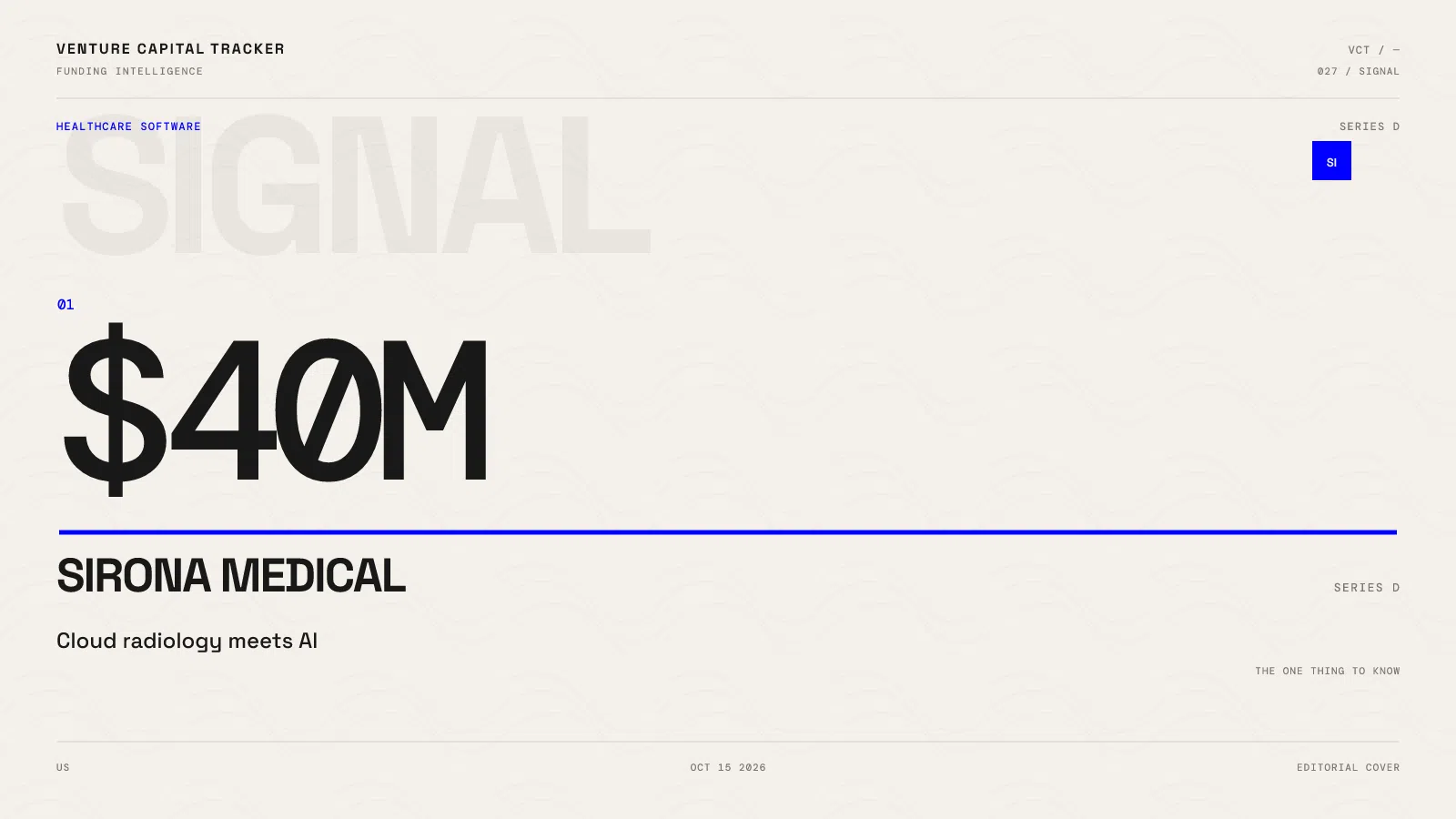
Avidity Partners has led a $40 million Series D for Sirona Medical, the radiology-software developer said on October 15, 2026. Backers also include Rose Park Advisors, GreatPoint Ventures, 8VC and KLT, alongside additional investors the announcement does not identify. The company did not release a valuation.
The financing backs a cloud-native radiology platform at a point when the investment question is shifting from selling AI features to delivering reliable clinical infrastructure. Sirona’s RadOS combines image archiving, diagnostic viewing, reporting, worklists and AI-supported workflows. Its next phase depends on implementation and recurring customer use—not simply the number of tools it can integrate.
What the $40 million is intended to fund
In its financing announcement, Sirona identifies customer implementation and support, commercialization of its Cortex AI orchestration layer, and international expansion among its priorities. The planned international program, Sirona Global, is scheduled to launch by year-end 2026.
Sirona also says the round funds its operating plan indefinitely. That is management’s forward-looking assessment, not an independently verified guarantee of permanent funding or current cash-flow profitability. The release does not provide the financial statements or cash-flow assumptions needed to reproduce that claim.
Contracted imaging volume is not completed work
Sirona reports contracts covering over 12 million primary imaging examinations annually. As of September 30, it reports revenue up 2.5 times year over year, contracted annual recurring revenue up 2.7 times, PACS archive usage up 2.5 times and submitted diagnostic reports up two times.
Those are different measures, and all are company-provided. Annual exams under contract are not proof that all those exams already run on the platform. Contracted recurring revenue is also distinct from recognized revenue and cash collected.
Our assessment is that conversion between those measures is the central commercial test. A large signed deployment can support future growth, but onboarding, migration and workflow adoption determine how much contracted activity becomes active, billable usage. Growth ratios without absolute revenue, retention and margin figures give only a partial view of the business.
Radiology infrastructure carries a delivery burden
A platform that consolidates several workflow components may reduce the friction of moving between systems. Consolidation can also make service reliability and migration quality more consequential: a problem in a central work environment can affect more of the customer’s day.
This is why implementation capacity deserves attention alongside product development. Investors should ask how much work a new site requires, how long activation takes, what support costs look like after launch and whether deployments become more repeatable over time. These are analytical questions, not evidence that Sirona has encountered a particular failure.
The same discipline applies to Cortex. An orchestration layer’s commercial value depends on useful, well-governed workflow integration. Announcing agentic capabilities does not by itself establish clinical performance or economic benefit.
The milestones that matter next
The most informative next disclosures would connect signed customers to live sites, contracted exam volumes to completed activity, and growth to durable customer economics. International expansion should be evaluated against those operational measures rather than counted as revenue before deployment.
The Series D is a meaningful financing for radiology software. Its significance lies in the opportunity to convert a growing contracted base into a repeatable infrastructure business, while keeping management projections separate from demonstrated financial results.
Related reporting
See Suki’s $90M Series E and healthcare-AI expansion and the Sirona Medical company profile.
Last updated:
Editorial note: AI tools assisted with research, structure, or drafting. Venture Capital Tracker retains human editorial responsibility for factual accuracy, relevance, and source quality before publication.