· Venture Capital · 3 sources · Updated · Verified
Pigment Raises $250M Series E at a $2.3B Valuation
Scaleup Europe Fund led Pigment's $250M Series E at a $2.3B post-money valuation. The test is whether autonomous planning converts reported ARR momentum into durable enterprise economics.

By Venture Capital Tracker
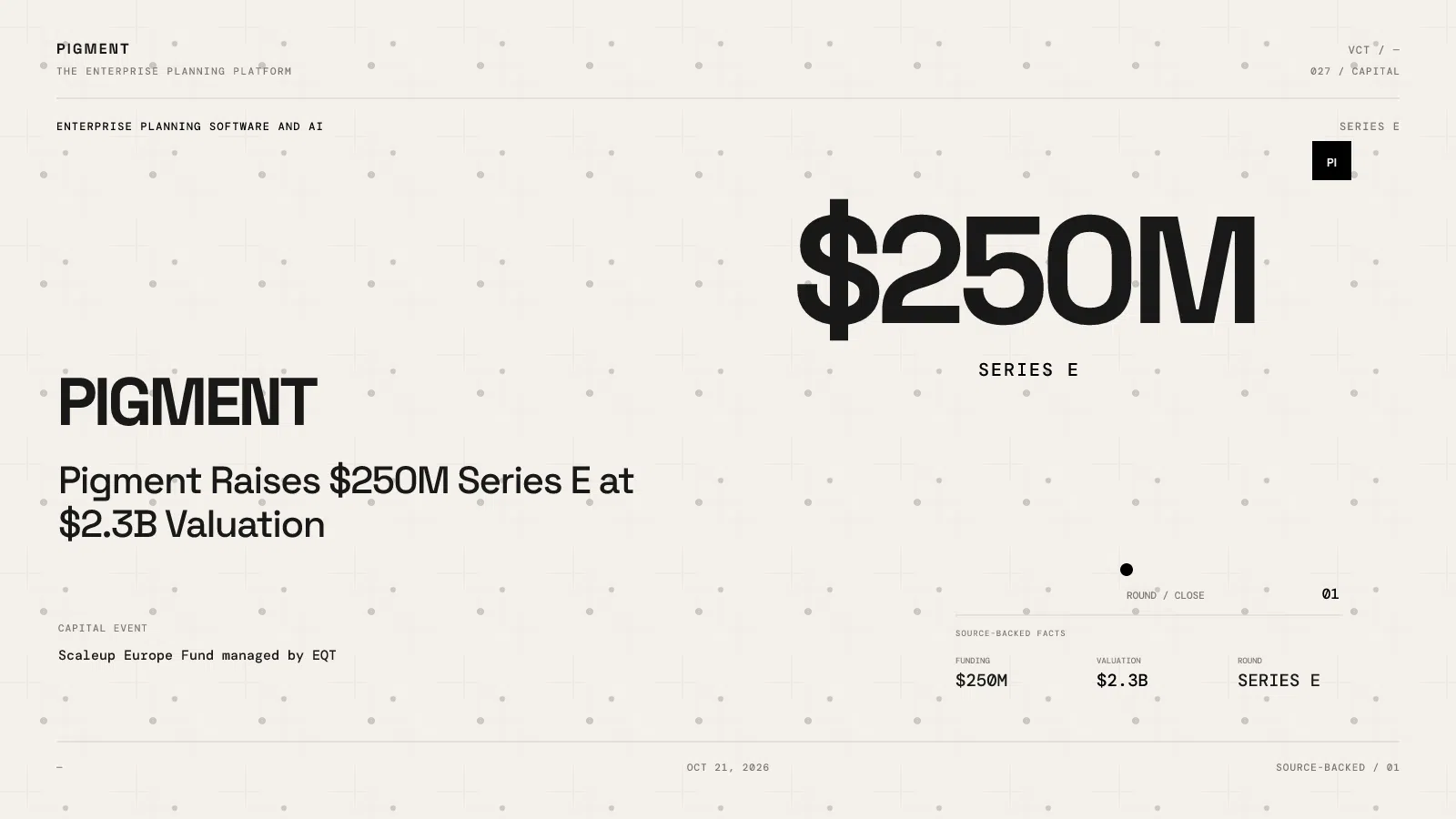
Pigment announced a $250 million Series E at a $2.3 billion post-money valuation on October 21, 2026. Scaleup Europe Fund, managed by EQT, led the round. WIL (World Innovation Lab), Greenoaks, ICONIQ Growth, IVP, and Meritech Capital participated.
The company also described an investment from NVIDIA as planned. Because that wording is forward-looking, NVIDIA is not included here as a completed-round participant.
Pigment's Series E funding is a scale bet
Pigment sells business planning and performance-management software to finance and operations teams. Its platform combines collaborative models, reporting, scenario analysis, and AI agents on a proprietary compute engine called Graphite.
The round is not simply a wager that enterprises want another planning interface. It is a bet that AI can move planning from periodic model-building toward continuous, governed decisions—and that Pigment can displace deeply embedded spreadsheets and incumbent platforms without sacrificing control.
Pigment said it surpassed $100 million in annual recurring revenue earlier in 2026 and again doubled year over year. Those figures are company-reported and were not independently audited in the reviewed announcement. The release does not disclose net revenue retention, gross margin, cash burn, customer concentration, or the cost of implementations.
Using the stated post-money valuation and a $100 million ARR floor produces a simple valuation-to-ARR ratio below 23 times. That is not a complete valuation multiple: ARR is not GAAP revenue, “surpassed” does not provide an exact denominator, and the round may include rights that matter to investors.
Autonomous planning raises the proof standard
Pigment says 85% of new metrics on its platform are now created by an agent. That is an adoption indicator, not evidence that 85% of planning work is automated or that the output reaches production without review.
Planning systems influence budgets, hiring, compensation, inventory, and capital allocation. An agent that builds a model quickly still needs reliable source data, permission controls, clear assumptions, deterministic calculations, and an audit trail. The value is not the number of generated metrics; it is whether teams make better decisions with less manual reconciliation.
This creates a more demanding competitive benchmark. Pigment must be easier to deploy than Anaplan, SAP, Oracle, IBM, and internally built spreadsheet workflows while remaining trustworthy enough for finance leaders. New AI features can attract evaluation, but renewals will depend on data quality, user adoption, model maintenance, and measurable cycle-time improvements.
Large customers validate demand—not economics
Pigment names enterprises including Danone, DirecTV, Siemens, Snowflake, ServiceNow, and Unilever. It also says Anthropic, ElevenLabs, and Uber use the product and that L'Oréal selected it for salary planning across more than 95,000 employees.
These references demonstrate enterprise relevance. They do not reveal contract value, deployment scope, implementation costs, or profitability. A large logo can range from a narrow team deployment to a global platform contract.
The most useful next disclosures would separate new-customer growth from expansion, quantify retention, and show how implementation effort changes as agents take on more work. If services requirements rise with customer complexity, reported ARR growth may not translate cleanly into software-like margins.
What the $2.3B valuation assumes
The valuation implies confidence that Pigment can become a durable system of record and action for planning, not merely an analytical layer beside existing tools. Three questions matter:
- Can AI features improve retention and expansion? Agent usage should translate into more workflows, users, and recurring revenue.
- Can Pigment preserve governance at scale? Deterministic outputs, permissions, and traceability are essential when agents affect financial decisions.
- Can deployment economics improve? Faster time to value and lower support intensity would strengthen gross margins and sales efficiency.
The Series E gives Pigment substantial capital to expand engineering and enter new markets. It also raises the performance bar. At a $2.3 billion valuation, product momentum must become durable enterprise economics.
The adjacent financial-workflow theme also appears in Mural's $15M Series A for agentic-finance infrastructure. Mural focuses on payments and treasury rails; Pigment focuses on planning and decision workflows. Both need to prove that agentic features create measurable value while preserving control.
- startup-fundraising
- ai
- enterprise
- +2 more
Follow Venture Capital Tracker in Google
Add VCT as a preferred source to make our venture-capital coverage easier to find in Google Search.
Last updated:
Editorial note: AI tools assisted with research, structure, or drafting. Venture Capital Tracker retains human editorial responsibility for factual accuracy, relevance, and source quality before publication.