· Venture Capital Tracker · venture-capital
Origin Emerges With $20M Total Funding for Interior-Construction Robots
Origin discloses $20M total funding led by Accel and Zacua. Its construction robots face a fleet-scaling test; individual rounds remain unitemized.
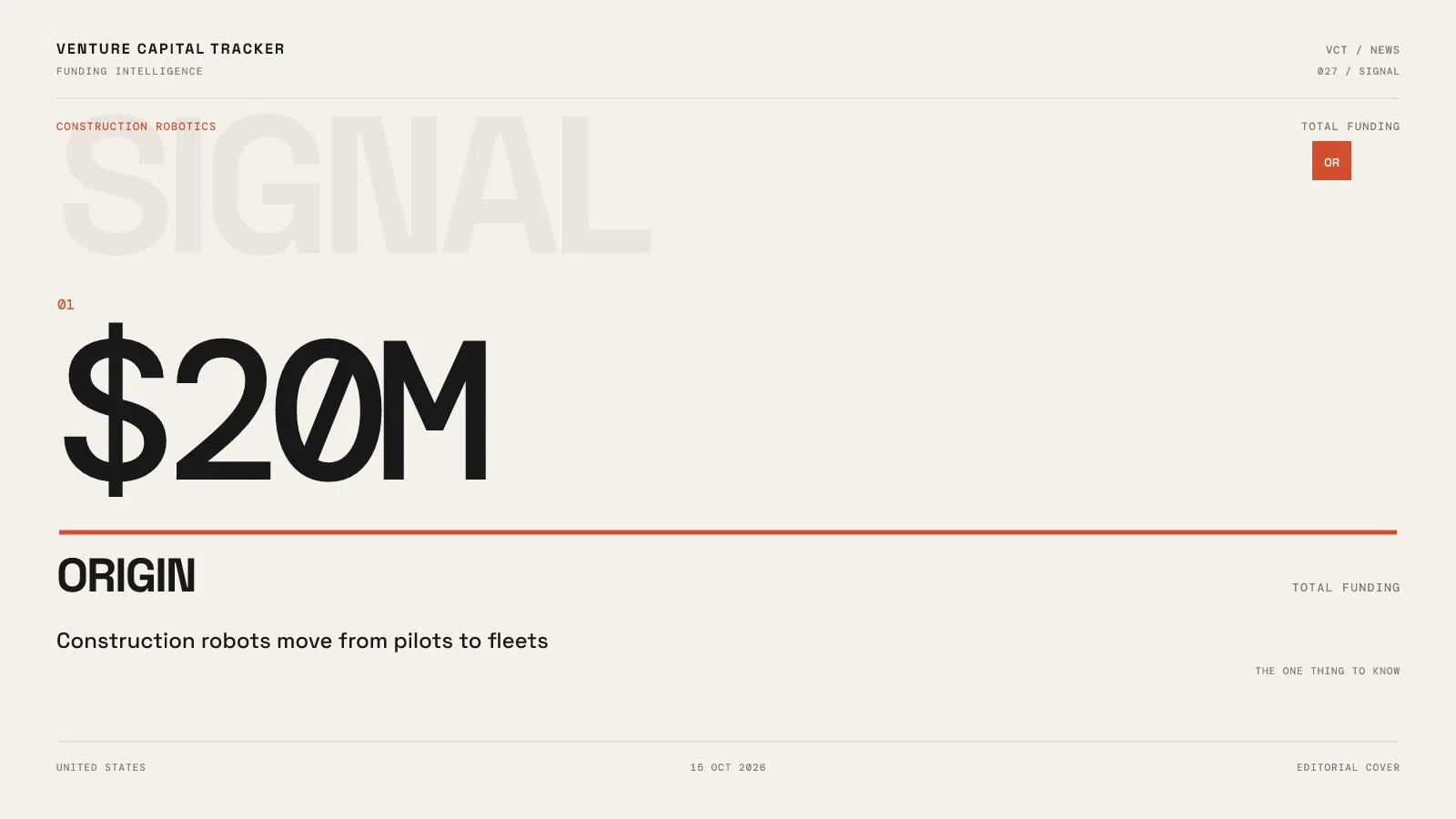
Origin, the San Francisco construction-robotics company behind OG-1, emerged from stealth on October 15, 2026 with cumulative funding of $20 million. Accel and Zacua Ventures co-led the disclosed backing.
The wording matters. The company disclosure gives cumulative funding, not the size and date of a single newly closed round. It does not disclose a formal stage or valuation.
Imad Ventures, ISAI, Z21, Schema Ventures and Unilazer Ventures are also named as backers. The investor list includes individuals associated with Tesla and 1X, as well as Skild AI and Anduril. Those affiliations should not be interpreted as corporate investments by the four companies.
A narrow starting job inside a broader robotics ambition
OG-1 starts with interior wall finishing: applying compound, sanding and priming. Origin describes interchangeable tools on a shared mobile platform, with additional trades planned over time.
The practical attraction is that a contractor can evaluate a specific task rather than buy an undefined promise of general-purpose autonomy. A wall-finishing workflow has observable output, deadlines and rework costs. That creates a more concrete starting point for measuring whether a robot adds useful capacity.
It also exposes difficult operational details. Moving equipment between work areas, maintaining tools and coordinating with other trades can matter as much as the speed of an individual robotic action.
Autonomous work does not mean a labour-free site
Origin says crews handle site mapping and material replenishment while the robot performs demanding tasks. This is a human-and-machine workflow, not a claim that all surrounding labour disappears.
Our analysis is that the relevant productivity measure is completed, accepted work per shift after setup, supervision and interruptions. A robot that performs a task quickly may still disappoint if it spends too much time waiting for access, materials or maintenance.
Conversely, reliable performance on repetitive or awkward work could create value even without replacing a full worker. Contractors may benefit through greater capacity, more consistent finishing or less time spent on difficult physical tasks.
The fleet target is a milestone, not current scale
Origin is targeting 150 deployed robots by the end of 2027. That is a company goal, not the size of its current installed base.
The funding will support deployment, fleet development and customer pilots. The next evidence should therefore concern repeat use and fleet support: how often robots are working, how much intervention they need and whether customers expand after the pilot.
Those metrics would also help establish the economics of manufacturing and servicing the machines. The announcement does not disclose pricing, gross margins or a payback period, so a dependable customer ROI calculation is not yet possible.
Generalisation must earn its way into the product
A modular platform could spread hardware development across several trades. But each new tool and workflow also creates fresh requirements for control, verification and customer acceptance.
The sensible investment test is not the number of tasks on a roadmap. It is whether skills learned in one deployment make the next task or site easier to serve without a proportional increase in engineering effort.
Bottom line
Origin's $20 million disclosure adds a distinct interior-construction robotics story to the funding landscape. The strongest next milestone is a repeatable fleet business with accepted work and manageable support costs—not simply a larger pilot list.
Editorial note: AI tools assisted with research, structure, or drafting. Venture Capital Tracker retains human editorial responsibility for factual accuracy, relevance, and source quality before publication.