Infinigence AI Closes RMB2.3B Series C for Cross-Chip AI Infrastructure
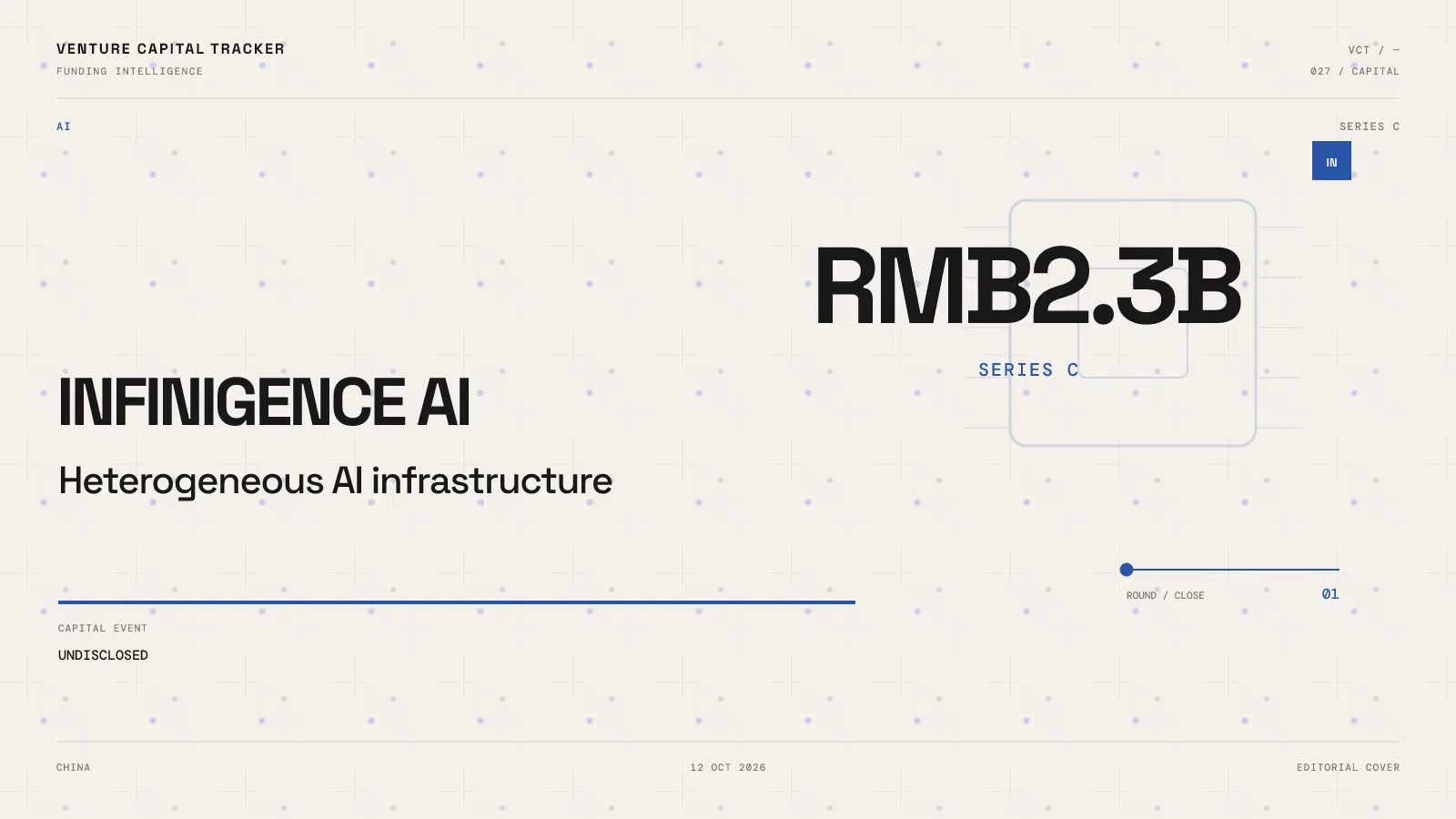
Infinigence AI's RMB2.3B Series C backs heterogeneous computing and inference services. RMB4.3B is cumulative funding; the latest syndicate remains unclear.
Infinigence AI Closes RMB2.3B Series C for Cross-Chip AI Infrastructure
Infinigence AI disclosed a completed RMB2.3 billion Series C on October 12, 2026, bringing cumulative funding to RMB4.3 billion, according to company-derived reporting by Sina Technology and TechNode.
The Shanghai company, also known as 无问芯穹, builds infrastructure for coordinating models and computing resources across different chip platforms. The round backs a software-and-services layer above the silicon, rather than one processor architecture or one foundation model.
What the financing does—and does not—disclose
| Field | Verified position |
|---|---|
| New financing | RMB2.3B Series C |
| Public disclosure | October 12, 2026 |
| Cumulative funding | RMB4.3B, not the new round amount |
| Valuation | Undisclosed in the reviewed financing reports |
| Current lead and full syndicate | Not established by the reviewed sources |
| Classification | Completed financing reported from company materials |
China Daily's coverage names Lenovo, Tencent, Baidu, HongShan, Qiming and Shunwei among the company's investors. It does not clearly identify that entire historical roster as the Series C syndicate. VCT therefore does not assign them all to the new round.
Amounts remain in RMB because published dollar conversions differ and add little to understanding the transaction.
The scarce resource may be usable compute
Infinigence's product description places heterogeneous computing, model training, inference and enterprise agents within a shared infrastructure strategy.
The commercial rationale is straightforward. Buying processors does not automatically produce reliable application capacity. Different architectures can require different software paths, scheduling decisions and operational expertise.
A cross-chip platform could reduce those burdens. Its value would come from turning fragmented resources into dependable workloads with measurable cost and latency characteristics.
That is also the execution challenge. Each additional chip family expands the support matrix. Model changes, driver updates and workload-specific behavior can turn apparent platform scale into a substantial engineering obligation.
Usage growth is not revenue growth
Infinigence says its platform reaches 37,000 petaflops across 16 chip types and that daily token calls increased fortyfold by July relative to December 2025. These are company-reported capacity and usage figures.
Connected capacity should not be treated as company-owned assets. Token calls should not be treated as revenue, and faster traffic growth does not establish attractive gross margins.
For investors, the useful questions are paid utilization, realized revenue per workload, hardware-access costs and the engineering expense of supporting heterogeneous deployments. A platform can grow usage quickly while passing most of the economic value to infrastructure suppliers or customers.
Where a durable advantage could emerge
A neutral infrastructure vendor benefits when customers need several chip ecosystems rather than a single vertically integrated stack. Reusable deployment tooling and accumulated production knowledge could make that role valuable.
But neutrality alone is not a moat. Chip vendors and cloud providers have reasons to improve their own software, bundle services and make workloads easier to retain. Customers may also prefer a narrower, deeply optimized environment for their most important applications.
The strongest evidence would be repeat production use across different hardware families, stable performance under realistic workloads and renewals that do not depend on exceptional support effort.
The investment read-through
The round belongs alongside VCT's coverage of Modal's infrastructure expansion and Oxide's integrated private-cloud model, while representing a different business architecture.
Infinigence is selling the ability to make diverse computing resources work together. Its Series C gives that thesis substantial capital. The next test is whether interoperability becomes a repeatable, profitable product rather than an expanding collection of custom integrations.
Editorial note: AI tools assisted with research, structure, or drafting. Venture Capital Tracker retains human editorial responsibility for factual accuracy, relevance, and source quality before publication.