· Venture Capital Tracker · venture-capital
GreenCell Mobility Raises ₹330 Crore to Deploy 4,500 Electric Buses
Impact Fund Denmark invested $35 million in GreenCell Mobility to support about 4,500 electric buses. The equity round's formal stage and valuation were undisclosed.
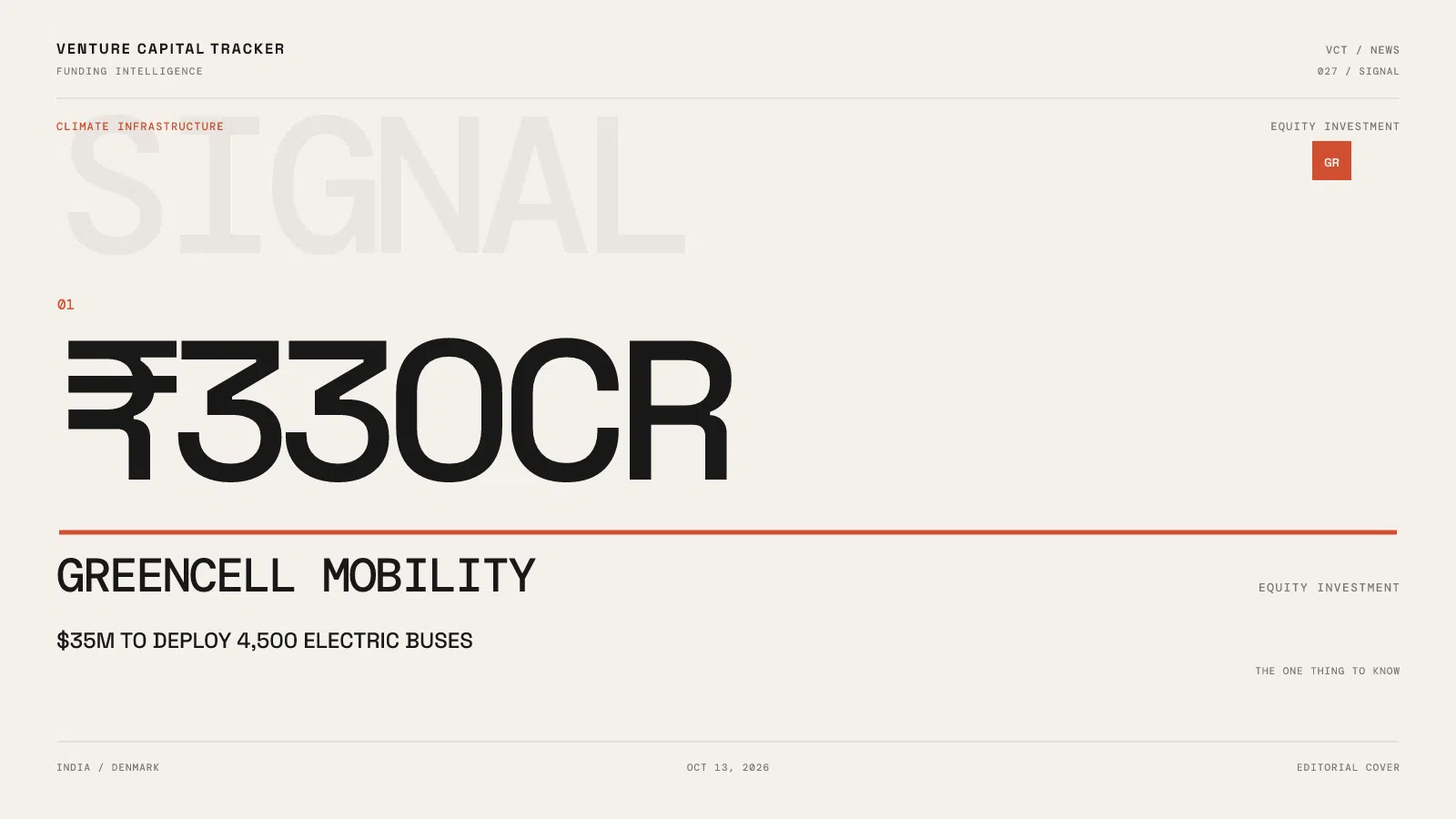
GreenCell Mobility has raised ₹330 crore in equity from Impact Fund Denmark to expand one of India’s largest electric-bus operating platforms.
Impact Fund Denmark describes its commitment as $35 million, or DKK 230 million, invested through Danish SDG Investment Fund II. GreenCell and Indian reporting use the ₹330 crore figure. The round’s formal stage, valuation and ownership terms were not disclosed.
What the capital is meant to finance
GreenCell says the money will support the rollout of about 4,500 electric buses now in its deployment pipeline. If that plan is delivered, its fleet would exceed 5,000 buses serving 105 Indian cities.
That use of funds makes this more than a conventional vehicle purchase. An electric-bus network requires depots, chargers, route operations, maintenance, drivers and reliable utilization alongside the buses themselves. GreenCell operates both urban services and the NueGo intercity brand, so execution spans different route lengths and charging patterns.
The investor is also notable. Impact Fund Denmark is Denmark’s development finance institution. Its capital comes through a sustainable-development vehicle backed by five Danish pension funds, placing the financing between commercial growth equity and development finance.
Why GreenCell raised equity after mezzanine financing
The October investment follows ₹800 crore, approximately $89 million, of mezzanine financing announced in January from IFC, British International Investment and Tata Capital, a distinction also reflected in transaction reporting.
Those instruments serve different purposes. Mezzanine capital combines characteristics of debt and equity and can help finance a capital-heavy expansion without immediately pricing a conventional equity round. The new ₹330 crore investment is explicitly equity, adding loss-absorbing capital as GreenCell expands its operating base.
The two transactions should not be combined and described as one round. They involve different instruments, investors and announcement dates. Nor should the October investment be assigned a Series label: neither GreenCell nor Impact Fund Denmark disclosed one.
The infrastructure thesis behind the deal
India’s electric-bus market is shifting from demonstration fleets toward large operating programs. For investors, the opportunity is not only manufacturing. It also includes the platforms that win routes, procure buses, build charging networks and keep vehicles productive.
GreenCell is backed by Eversource Capital, the climate-investment manager formed by Everstone and Lightsource bp. Existing institutional relationships with IFC, British International Investment and Tata Capital give it access to capital providers accustomed to infrastructure risk.
The fresh equity gives the company more capacity to execute its order book, but the targets are still forward-looking. Fleet size and city coverage should be attributed to GreenCell, and deployment risk remains material. Delays in vehicles, depots, grid connections or route approvals could slow the expansion.
What competitors missed
Indian coverage correctly leads with the ₹330 crore headline and the 4,500-bus plan. The more useful financing angle is the capital stack: a development-finance equity investment layered onto substantial mezzanine funding earlier in the year.
That structure reflects the economics of electric mobility. Venture-style equity alone is rarely sufficient for thousands of vehicles and their supporting infrastructure. GreenCell’s model depends on matching long-duration institutional capital with contracted or visible transport demand.
What to watch next
The first test is delivery. Investors should track how many of the planned buses enter service, where the 105-city footprint develops and whether charging and maintenance capacity keep pace.
The second is capital efficiency. A larger fleet does not automatically produce attractive returns; utilization, route density, electricity costs and service reliability will determine whether the platform generates durable cash flow.
Bottom line
GreenCell’s ₹330 crore/$35 million equity investment is a confirmed climate-infrastructure financing led by Impact Fund Denmark. It is not a disclosed Series round, and it is separate from the company’s January mezzanine package. The financing is significant because it backs the operating layer of India’s electric-bus transition, with about 4,500 vehicles still to be deployed.
Last updated:
Editorial note: AI tools assisted with research, structure, or drafting. Venture Capital Tracker retains human editorial responsibility for factual accuracy, relevance, and source quality before publication.