· Venture Capital · 7 sources · Verified
BOB Raises $5.5M for an AI Finance Employee With No Subscription
Mischief led BOB’s $5.5M seed. Its AI finance assistant is free because banking income pays for the software—a model that still needs to prove its economics.

By VCT Editorial
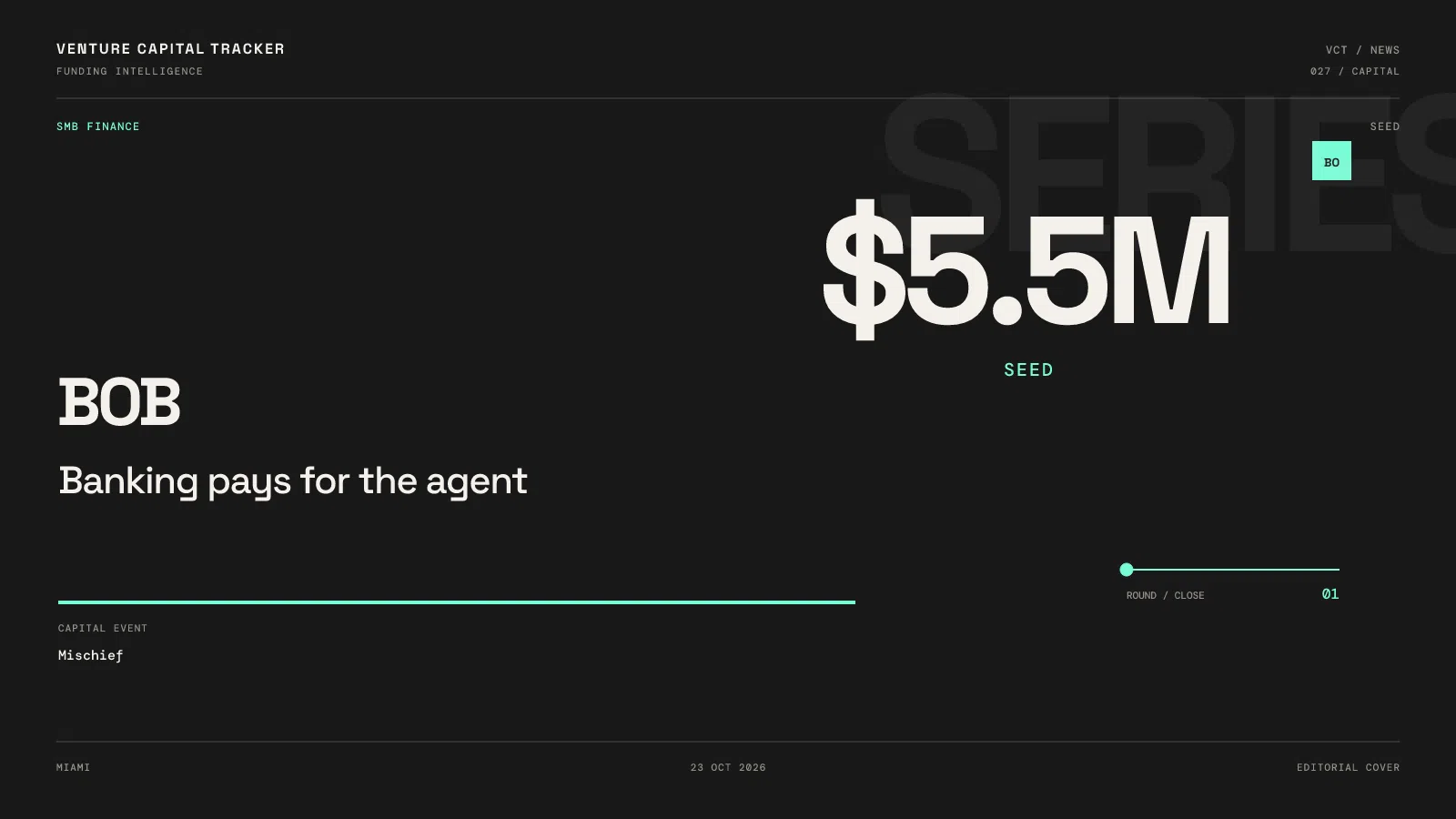
BOB has raised $5.5M in seed funding led by Mischief to build an AI finance employee for small businesses. Its October 23 announcement follows a September private beta.
The commercial proposition is more specific than another chatbot for bookkeeping. BOB advertises a $0 software subscription and says banking income pays for the agent. That makes the financing a bet on winning business banking relationships as well as automating administrative work.
Peter Thiel, Codie Sanchez, Mark Pincus and Karman Ventures also participated, alongside unnamed investors and operators. Individual commitments, valuation and an exact legal closing date were not disclosed. The capital will support product development, onboarding and hiring in Miami.
What the owner hands over
BOB targets owners of businesses such as roofing contractors, restaurants and local service firms. It says it handles books, invoices, payments and cash-flow questions through messaging tools, including WhatsApp, Slack and email.
Consider an illustrative roofing business. After finishing a job, the owner normally checks the estimate, prepares an invoice, follows up with the customer and later reconciles the payment. BOB’s proposed workflow lets the owner request that work conversationally, using connected financial tools. This is an illustration of its stated capabilities, not a documented customer outcome.
Its product details describe read-only access at setup, individually granted permissions and dollar thresholds for approval. Those controls matter more than the conversational interface when software can affect real accounts.
The site says actions are logged and reversible. That is a vendor claim, not independent proof that every completed payment can be recalled. Owners would still need to understand which actions require approval and what happens when a transaction fails.
How free software could earn its keep
BOB says it earns on deposits when customers use its banking offering. It does not disclose the revenue share, average balances or cost of serving an account.
Its website identifies Erebor Bank, N.A. as the deposit-service provider and explicitly says BOB is a fintech, not a bank. It also distinguishes bank deposits from crypto and blockchain settlement rails, which are not deposits or FDIC-insured.
Our assessment is that the model depends on customers keeping useful balances, not simply signing up for free software. AI processing, onboarding and human support still cost money. A convincing business would need enough retained banking income to cover them.
In Refresh Miami’s October 22 founder interview, CEO Adam Wininger said 500 businesses had signed up. That is an attributed signup count, not 500 paying customers or independently measured savings.
The investor bet—and the alternatives
Mischief partner Dustin Moring frames the investment in BOB’s release around AI moving from advice into execution. That is the investor’s stated thesis, carried in the company statement. Mischief’s own site describes an early-stage, founder-led investment approach; no separate BOB investment memo was located.
The near-term catalyst is concrete: BOB is taking its beta product into broader onboarding. Whether owners repeatedly delegate financial work safely is still an operating test.
Two accounting-finance comparisons help define the market. Truewind announced a $13M Series A in December 2024, co-led by Rho Capital and Thomson Reuters Ventures, for software supporting accounting professionals. BOB instead puts the owner and banking relationship at the centre.
Kick disclosed $20M raised in November 2025. That was a cumulative funding statement, not a separately disclosed $20M round. Its bookkeeping automation and accounting-firm distribution offer another route to reducing the same administrative workload.
A separate model appears in Matters’ $5M pre-seed: consumer banking funded by subscriptions rather than BOB’s deposit-side proposition. The decisive numbers for BOB will be retained balances, revenue after service costs and financial tasks completed correctly without owners redoing the work.
Follow Venture Capital Tracker on Google
Add VCT as a preferred source to see more of our venture-capital reporting in Google Search.
Editorial note: AI tools assisted with research, structure, or drafting. Venture Capital Tracker retains human editorial responsibility for factual accuracy, relevance, and source quality before publication.