· Venture Capital · 3 sources · Updated · Verified
ASI Raises $325M Series C at a $3B Valuation
Spark Capital led ASI's $325M Series C at a $3B valuation. Contract scale supports the critical-infrastructure AI thesis, but awards, recognized revenue, and durable margins are different measures.

By Venture Capital Tracker
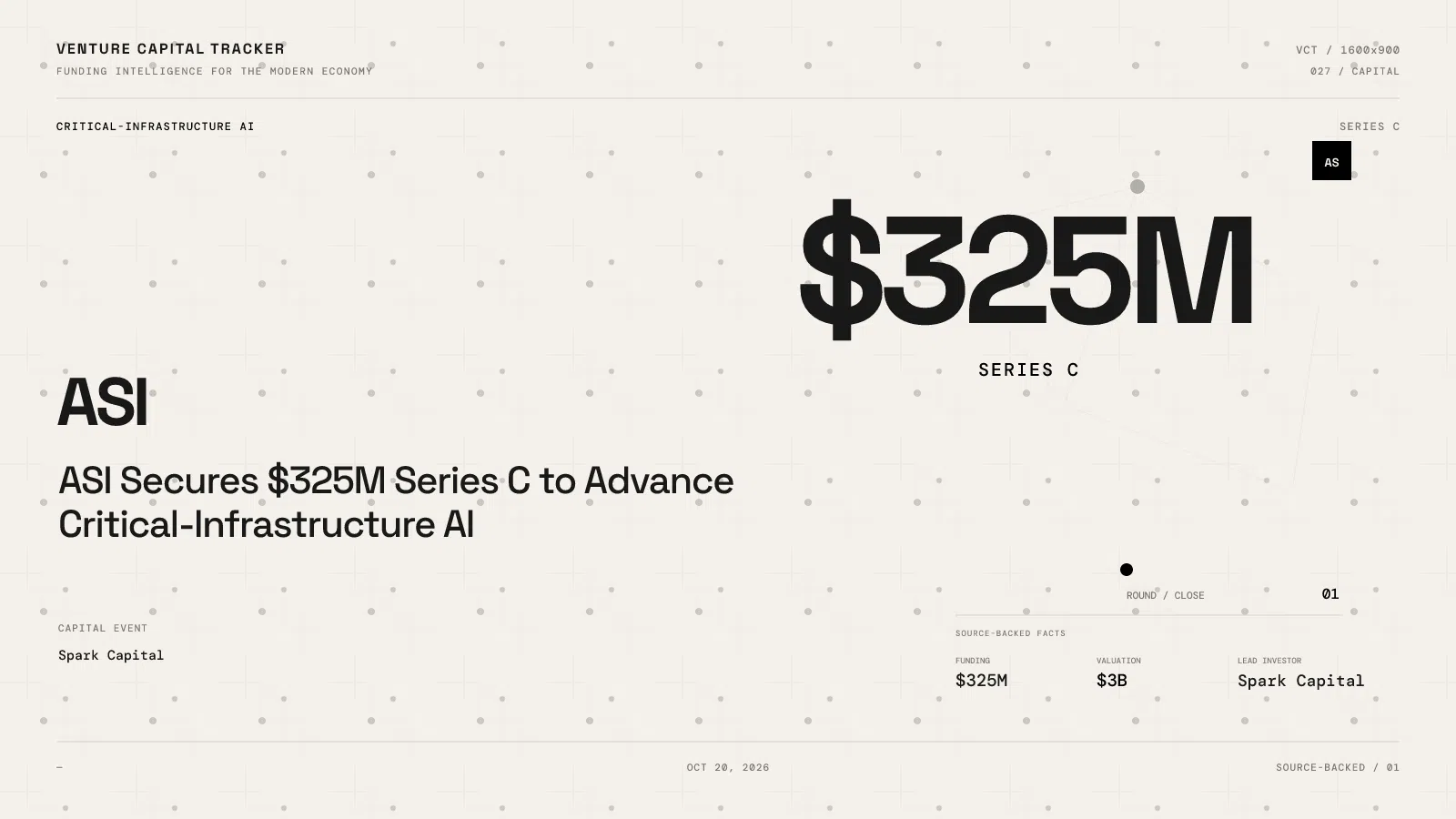
ASI, formerly Air Space Intelligence, announced a $325 million Series C at a $3 billion valuation on October 20, 2026. Spark Capital led the financing. Affiliates of Citadel Securities, Meritech Capital, Craft Ventures, Energy Impact Partners, and Andreessen Horowitz participated.
The Boston company develops AI systems that simulate and optimize physical operations across aviation, defense, energy, and logistics. Valuation was disclosed; the announcement did not specify whether the figure is pre- or post-money.
ASI's Series C funds critical-infrastructure AI
Most generative-AI products operate on text, images, or code. ASI is pursuing a different layer: models that forecast how interconnected physical systems will behave hours, days, or weeks ahead.
That positioning matters because operational decisions have measurable consequences. Airlines care about delays and asset utilization. Grid operators care about reliability and storm response. Defense customers care about logistics, command systems, and mission readiness.
ASI says its technology is used by the U.S. Department of Transportation, the Federal Aviation Administration, the U.S. Army, the U.S. Air Force, National Grid, and major airlines. The company plans to use the Series C to expand deployments in energy, logistics, and tactical-edge environments and grow research and engineering in Boston.
Contract value is not current revenue
ASI highlights an $875 million, 12-year FAA program and a $99 million, five-year U.S. Army contract. These awards provide evidence of customer demand and long procurement horizons. They should not be read as current annual revenue.
Government contract values may represent ceilings, planned task orders, options, or spending over many years. Revenue is recognized as products and services are delivered, and actual realization can depend on appropriations, milestones, scope, renewals, and performance.
The financing announcement does not disclose ASI's revenue, backlog definition, gross margin, burn rate, or customer concentration. Investors should therefore separate three numbers:
- the maximum or announced value of a program;
- the amount contracted or obligated;
- revenue recognized during a reporting period.
The distinction is essential when comparing ASI's $3 billion valuation with commercial software companies.
Reliability is part of the product
Predicting a disruption is useful only if an operator can trust the recommendation and act in time. That makes data quality, latency, explainability, uptime, cybersecurity, and human oversight core product requirements rather than compliance add-ons.
Mission-critical deployments can create switching costs. They can also produce long integrations, demanding service obligations, and costly certification or security work. ASI's economics will depend on how much of each deployment becomes repeatable software and how much remains customer-specific engineering.
The strongest moat would combine proprietary operational data, proven outcomes, difficult-to-replicate integrations, and recurring contract structures. A large model alone is unlikely to be sufficient.
The competitive field is broader than AI startups
ASI competes with legacy aerospace and defense contractors, industrial optimization vendors, internal operations teams, and decision platforms such as Palantir. Incumbents bring certifications, procurement relationships, and installed infrastructure. Startups can move faster, but they must earn trust in environments with little tolerance for error.
The Series C suggests investors believe ASI can become an orchestration layer across multiple sectors. Cross-sector reuse would be powerful: a shared simulation and reasoning platform could spread R&D costs across aviation, energy, defense, and logistics.
The risk is fragmentation. Each market has different data, regulation, procurement cycles, and failure modes. If every deployment requires extensive customization, revenue growth may carry services-heavy costs.
What the $3B valuation needs to prove
The next useful disclosures are not more contract headlines. They are evidence that contracted demand converts into durable economics:
- annualized and recognized revenue, not only program ceilings;
- renewal and expansion rates across government and commercial customers;
- gross margin after implementation and mission-support costs;
- concentration by customer and program;
- operational outcomes such as fewer delays, faster response, or lower system costs.
ASI's $325 million round gives it the balance sheet to pursue programs that smaller software companies cannot. The investment case rests on whether high-stakes adoption becomes repeatable, defensible, and profitable at scale.
The same industrial-AI question appears in Mind Robotics' $500M round: how much value comes from reusable software and models, and how much depends on capital-intensive deployment inside physical operations.
- series-c
- startup-fundraising
- ai
- +2 more
Follow Venture Capital Tracker in Google
Add VCT as a preferred source to make our venture-capital coverage easier to find in Google Search.
Last updated:
Editorial note: AI tools assisted with research, structure, or drafting. Venture Capital Tracker retains human editorial responsibility for factual accuracy, relevance, and source quality before publication.