· Venture Capital · 2 sources · Updated · Verified
Ara Energy Fund I Closes With $1.8B in Commitments
Ara Energy Fund I reached final close with $1.8B in commitments and over $700M of separate co-investment. We examine the structure and operating risks.

By Venture Capital Tracker
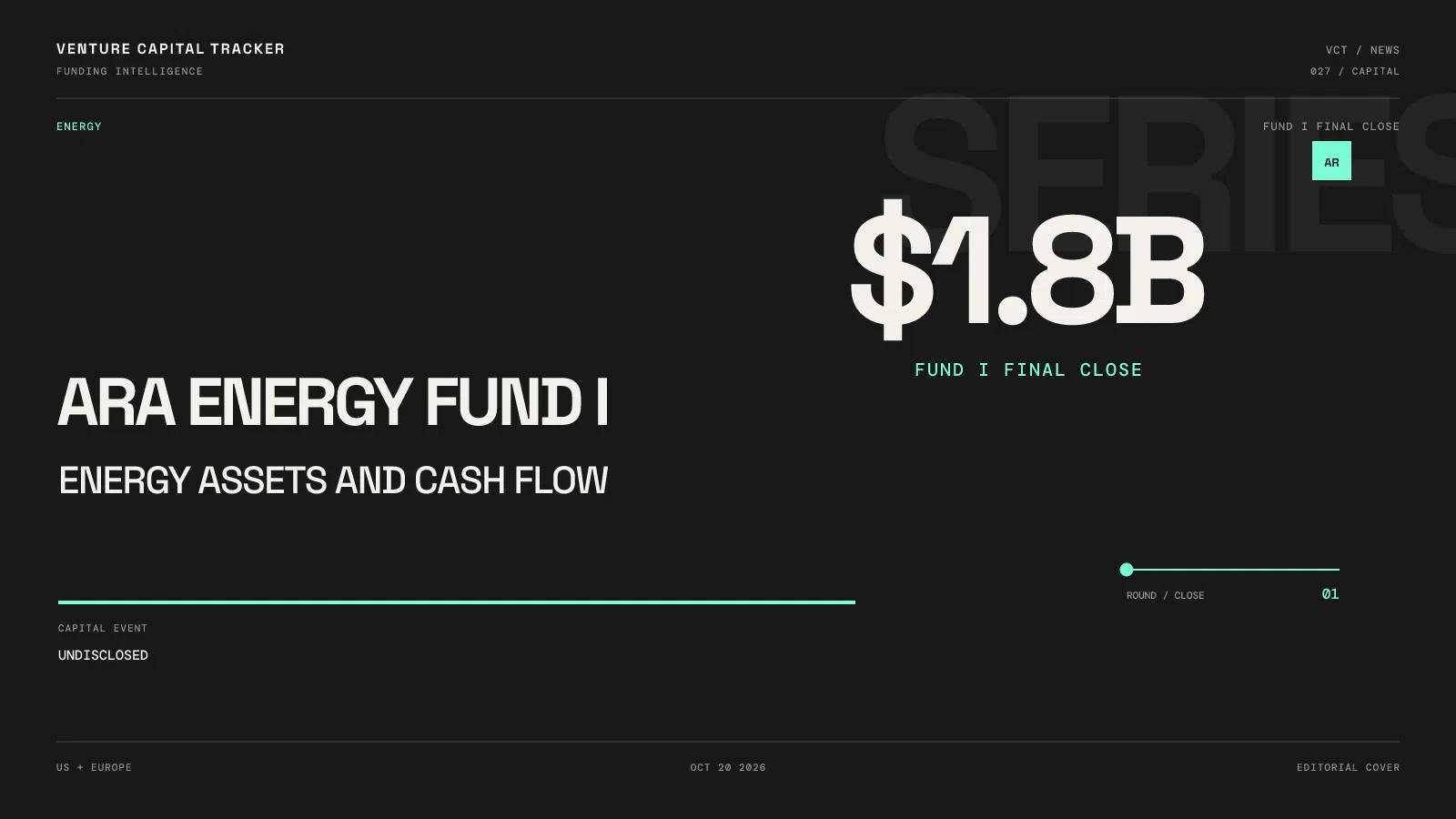
Ara Partners announced the final close of Ara Energy Fund I with $1.8 billion in fund commitments on October 20, 2026. More than $700 million of associated co-investment takes capital for the strategy to approximately $2.5 billion.
Those are separate pools. The $1.8 billion figure belongs to the fund; the larger strategy total includes capital alongside it. Commitments also do not establish how much cash has already been called or invested. The transaction is a private-equity and infrastructure fund close, rather than a startup financing.
What the fund will own
Ara's Energy strategy targets operating power, biofuels, and fuel-distribution businesses. It seeks to improve reliability and cash generation while reducing emissions where the economics support it. The approach centers on existing assets and proven technology.
The manager says the strategy's initial portfolio includes roughly 3 gigawatts of thermal power, ethanol capacity of about 400 million gallons a year, and an interest in the JET fuel-retail network. These are operating-capacity measures, not fund revenue or returns.
This is a different investment problem from funding a new battery chemistry or an unproven energy startup. The underwriting starts with asset cash flow, maintenance obligations, commodity exposure, and the price paid. Operational improvements must compensate for those risks.
Why the co-investment distinction matters
Co-investment can give investors more exposure to particular assets without increasing the headline size of the main fund. Its deployment, fees, governance, and concentration can differ from the pooled vehicle. Ara did not disclose those terms.
For readers comparing fundraising announcements, adding the two categories into a single fund-size ranking obscures the structure. VCT therefore records one $1.8 billion final-close event and describes the associated capital separately. It does not create a second $700 million close or assume that every dollar is deployed.
The announcement describes institutional backing from North America and Europe but does not identify individual commitments. Its partnership with HF Capital establishes a strategy relationship; the primary release does not allocate an LP check to that partner.
The operating thesis—and the price risk
Existing infrastructure may offer current cash flow, established customers, and fewer technology-development milestones than a startup. Those characteristics do not remove execution risk. A power plant can require major maintenance, fuel contracts can move against the owner, and operating permissions can constrain utilization.
Scarcity can also increase acquisition prices. If buyers compete for the same reliable assets, stronger demand may be captured by the seller through a higher purchase multiple. A larger fund only creates value if the manager can invest at prices that leave room for maintenance, financing costs, and a satisfactory return.
Ara's framing makes economic decarbonization an operating choice. Investors should examine each project's incremental cost, expected savings, payback period, and effect on asset life. A credible improvement plan needs an evidence-based baseline and a way to distinguish lower emissions intensity from increased total output.
What LPs should measure
The useful questions now concern deployment and operating results:
- How much committed capital has been called, and at what acquisition prices?
- How much return comes from cash generation versus borrowing or changes in valuation multiples?
- What maintenance and environmental obligations were inherited?
- How much exposure is concentrated in power, fuels, and retail distribution?
- Which emissions improvements have measurable operating benefits?
The final close confirms fundraising success. It does not provide a realized-return record for the new vehicle. Ara did not publish fund-level fees, carried interest, borrowing limits, or realized performance in the announcement.
For comparison with conventional venture vehicles, see VCT's coverage of Inspired Capital's $450M Fund IV. The amounts can be compared as commitments, but the underlying duration, cash-flow profile, and risk differ substantially.
Follow Venture Capital Tracker in Google
Add VCT as a preferred source to make our venture-capital coverage easier to find in Google Search.
Last updated:
Editorial note: AI tools assisted with research, structure, or drafting. Venture Capital Tracker retains human editorial responsibility for factual accuracy, relevance, and source quality before publication.