· Venture Capital Tracker · venture-capital
Anduril Opens Up-to-$1.3B Employee Tender at Roughly $90B Implied Valuation
Anduril's reported employee tender runs October 13–November 9 at $94.80 a share. The $1.3B cap is secondary liquidity, not a completed funding round.
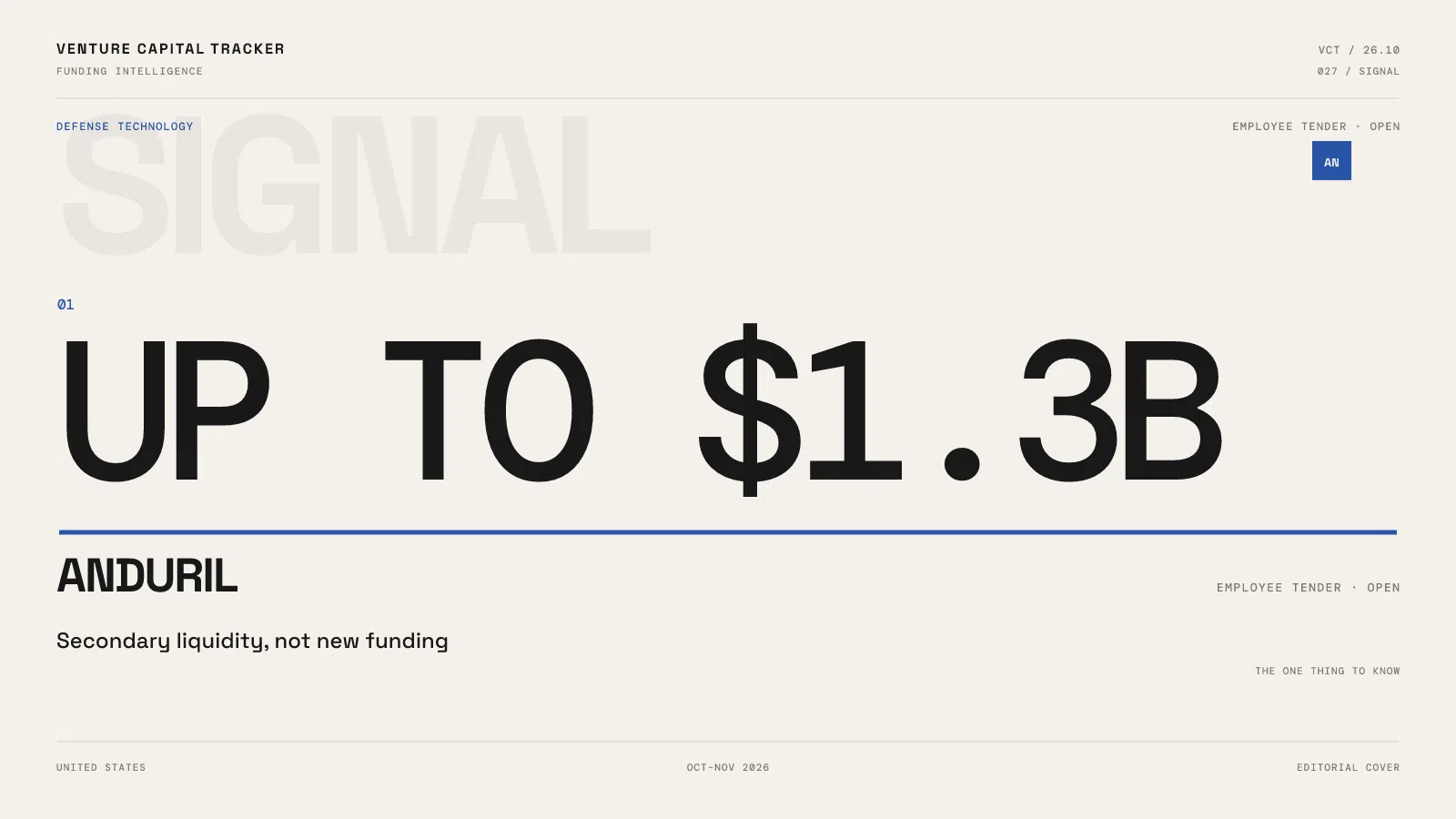
Anduril has opened an employee share tender capped at $1.3 billion, implying a valuation of roughly $90 billion. The offer is open—not a completed $1.3 billion capital raise.
The Orange County Business Journal reported on October 15 that employees can sell at $94.80 per share during a window running from October 13 to November 9, 2026. It cited CNBC's reporting and said CNBC had obtained company confirmation.
What is confirmed through reporting—and what is not
| Item | Reported terms |
|---|---|
| Transaction | Employee secondary tender |
| Maximum size | Up to $1.3 billion |
| Price | $94.80 per share |
| Implied valuation | Approximately $90 billion |
| Offer window | October 13–November 9, 2026 |
| Buyer identities and completed volume | Not disclosed in the reviewed report |
Eligibility reportedly extends to employees in 16 countries. The maximum is an offer cap, not evidence that every eligible holder will sell or that buyers will purchase the full amount.
Why this is not another Anduril funding round
In a primary financing, a company issues securities to raise capital. An employee secondary sale instead gives existing holders a route to turn shares into cash. The two can coexist, but they should not be added together as though both funded company operations.
VCT previously covered Anduril's separate $5 billion Series H at a $61 billion valuation. The October tender is a new liquidity event, not a revision of that round's announced proceeds.
The reviewed tender report does not identify buyers. Previous investors should not automatically be assigned new checks simply because they participated in the earlier financing.
What the higher implied valuation can—and cannot—tell us
A tender price offers a useful indication of what participating buyers will pay under a particular transaction's terms. It is not equivalent to continuous public-market price discovery.
Share class, rights, transfer restrictions and the pool of eligible sellers can affect comparability with a preferred financing. The public reporting does not provide enough detail to establish that every share class or holder could transact on identical terms.
For that reason, the roughly $90 billion figure is best described as tender-implied. It does not establish a new balance-sheet funding total or justify a precise operating multiple without additional financial disclosures.
Liquidity can help retention without setting an IPO date
For employees, a controlled sale can reduce the pressure to wait indefinitely for an exit. It can also let a private company provide some liquidity while keeping most equity exposed to its long-term outcome.
There are trade-offs. Eligibility rules and individual sale limits determine who actually benefits, while the eventual participation rate will reveal more than the headline cap. A large authorization does not guarantee broad uptake.
Nor does a tender establish an IPO timetable. An employee liquidity window and a public listing solve different problems; one should not be treated as confirmation of the other.
Bottom line
The opportunity is a significant secondary-liquidity story in defense technology. The next factual milestone is completion and disclosed take-up after the scheduled November 9 close—not adding $1.3 billion to Anduril's primary funding history today.
Editorial note: AI tools assisted with research, structure, or drafting. Venture Capital Tracker retains human editorial responsibility for factual accuracy, relevance, and source quality before publication.