Turbine Capital Closes SEK608M Fund I for Nordic Deep Tech
Turbine Capital closed its debut Nordic deep-tech fund at SEK608 million, backed by Mycronic, Saab, Scania, Volvo Cars, Stena, Saminvest and EIF.
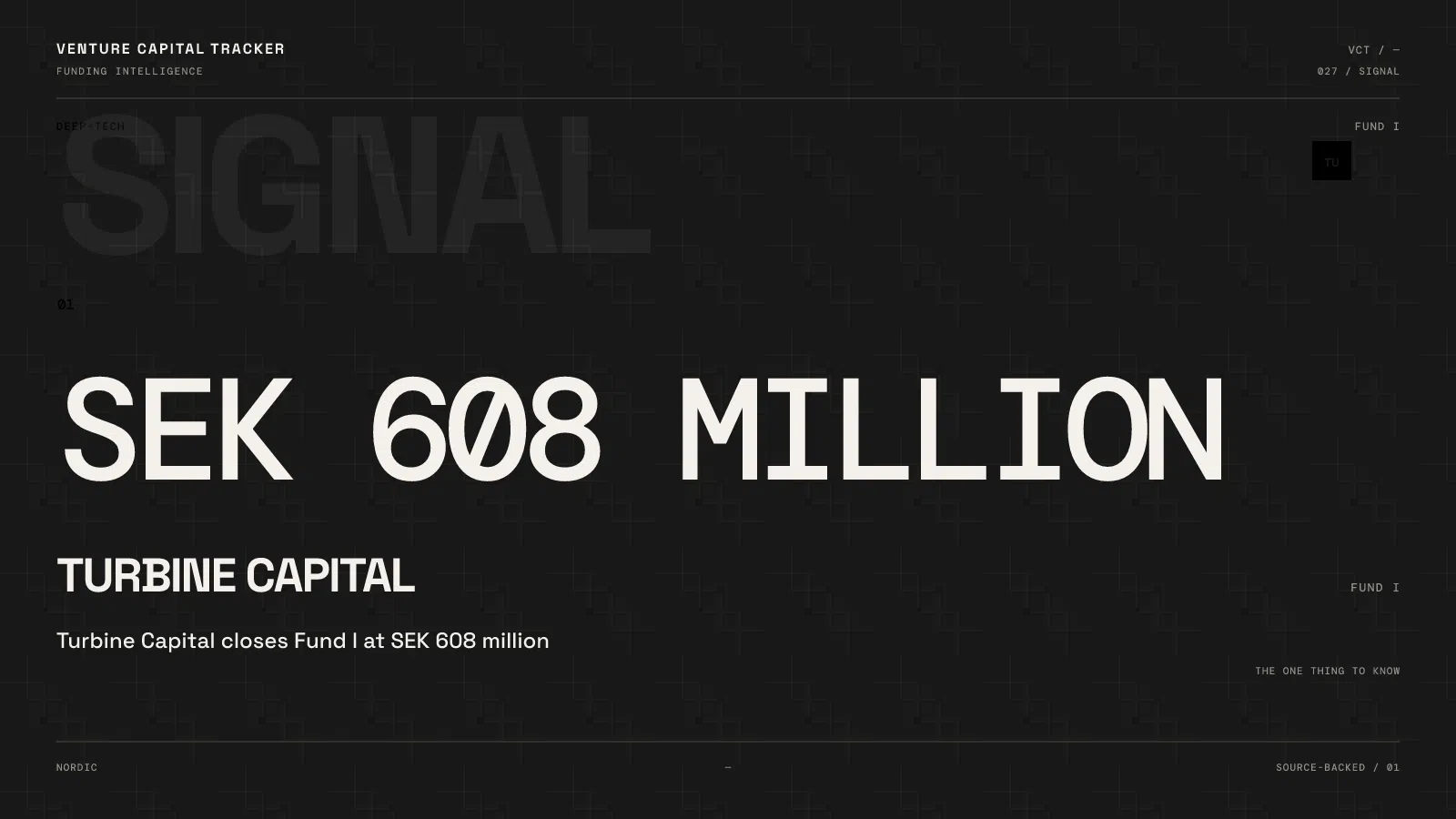
Turbine Capital has closed its first fund at SEK 608 million to invest in early-stage Nordic deep-tech companies.
The Stockholm-based manager announced the final close on October 9, 2026. Mycronic joined as a new industrial limited partner alongside Saab, Scania, Volvo Cars and Stena. Institutional backers include Sweden’s Saminvest and the European Investment Fund.
The fund at a glance
- Manager: Turbine Capital
- Vehicle: Turbine Capital Fund I
- Final close: SEK 608 million
- Previously stated target: SEK 750 million
- Stage: Pre-seed through Series A
- Focus: Nordic deep tech, including semiconductors, industrial digitalisation, space and climate-relevant infrastructure
- Fund life: 15 years
- Industrial LPs: Mycronic, Saab, Scania, Volvo Cars and Stena
- Institutional LPs: Saminvest and the European Investment Fund
The final close reached about 81% of the SEK 750 million target disclosed when the European Investment Fund announced its commitment in April. Turbine still finished above SEK 600 million and added an industrial investor with direct relevance to semiconductors and advanced manufacturing.
A corporate network built into the fund
Turbine’s pitch is not only patient capital. It is a shared diligence and commercialization network connecting startups, universities and large industrial companies.
Seven university-affiliated incubators—ABI, Uminova, UIC, Sting, LEAD, GU Ventures and IDEON—feed research-intensive companies into the manager’s pipeline. Industrial LPs then offer technical feedback, potential customer relationships and knowledge of regulated supply chains.
This structure can help deep-tech founders test whether a laboratory result solves a costly industrial problem before committing years of capital to scale-up. It also gives corporates an early view of technologies that may become suppliers, partners or acquisition targets.
The risk is governance. A startup’s best commercial path may not align with the priorities of any single corporate LP. Turbine will need to preserve independent investment decisions and avoid turning the portfolio into a collection of bespoke development projects.
Why Mycronic matters
Mycronic makes high-precision production equipment for the electronics industry. Its addition broadens a corporate group already spanning defence, transport, electrification and shipping.
For Turbine, Mycronic adds expertise in semiconductor manufacturing, photonics and electronics production—the point where many European deep-tech companies struggle to move from prototypes to repeatable output.
The timing is relevant. European governments and industrial groups are trying to strengthen domestic capacity in chips, defence electronics and critical infrastructure. Turbine’s portfolio can benefit from that demand, but policy support does not remove manufacturing risk or shorten qualification cycles.
Patient capital, with a finite portfolio
Turbine uses a 15-year fund life, longer than the conventional 10-year venture model. That is a practical response to deep tech: semiconductors, advanced materials and space hardware often need more time for certification, factories and customer adoption.
The manager says it has made seven investments and aims to build a portfolio of around 25 companies. That implies a selective pace and leaves room for follow-on reserves, although Turbine has not disclosed its check-size policy or reserve ratio.
The investment signal
Turbine Fund I is notable less for its absolute size than for who supplied the capital. Saab, Scania, Volvo Cars, Stena and Mycronic are not passive brand names; they represent industrial domains where Nordic deep-tech companies must prove reliability and secure reference customers.
At SEK 608 million, the vehicle is smaller than its original target. Its advantage will depend on whether the corporate-incubator network converts access into faster validation without compromising founder independence.
If that balance works, Turbine offers a model for Europe’s deep-tech funding gap: long-duration venture capital linked to customers and manufacturing expertise, rather than capital operating in isolation.
- fund-close
- venture-capital
- early-stage
- +2 more
Editorial note: AI tools assisted with research, structure, or drafting. Venture Capital Tracker retains human editorial responsibility for factual accuracy, relevance, and source quality before publication.