Revel's $150M Series B: EV Ride-Hail + Fast Charging Is a Real Business Model
Revel's Series B strengthens its NYC and LA fleet-plus-charging thesis — capital rewarding operators that combine asset ownership with urban EV infrastructure.
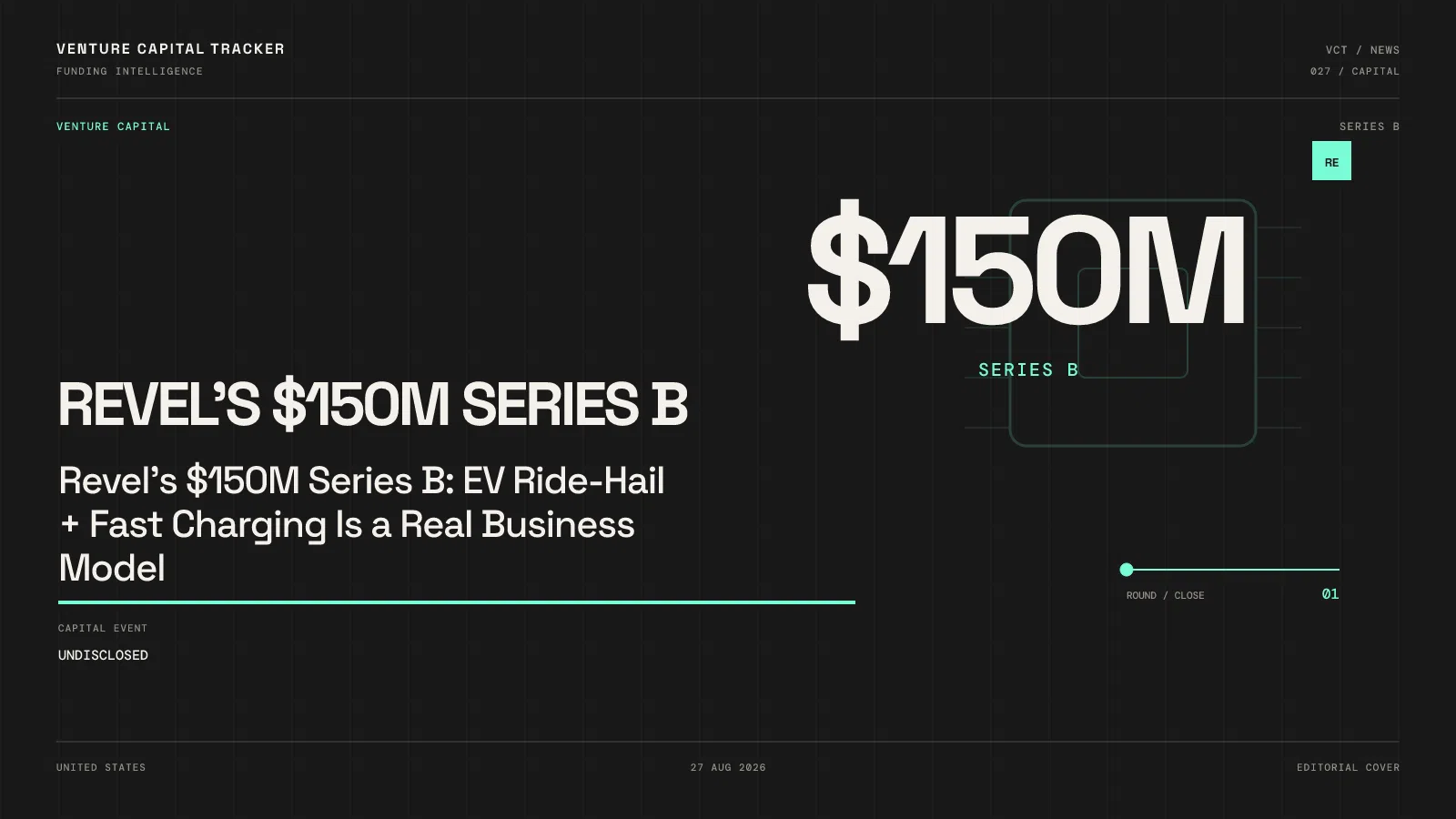
NYC and LA-based Revel raised $150M Series B in March 2026. Revel operates an all-electric ride-hail fleet paired with its own urban DC fast-charging depots, a vertically integrated model that early critics called overly capital-intensive.
The problem this startup is attacking
Dense-city EV fleet operators rarely have reliable access to reasonably priced DC fast charging. Owning the charging infrastructure compresses the largest operating expense — electricity / downtime — and opens B2B revenue (third-party charging).
Why this is a live problem now
- Uber/Lyft fleet-electrification commitments face real-world downtime costs.
- Utility interconnection queues make urban DC fast charging a moat, not a commodity.
- Ride-hail margins favor vertically integrated operators with predictable energy costs.
Competitive map
- Tesla Supercharger network (now multi-brand).
- EVgo, ChargePoint, BP Pulse, Electrify America.
- Uber / Lyft fleet partnerships with rental companies.
Market signal (the number to remember)
- $150M Series B in a high-capex urban mobility company is a signal that investors are again willing to underwrite physical infrastructure — provided unit economics hold up at depot and fleet level.
Practical takeaway (operator + investor)
- Operators: Infrastructure-backed ride-hail must prove $/kWh, driver-hour utilization, and depot IRR to attract next-round capital.
- Investors: The "vertical integration" thesis is back — in EVs, robotics, and AI — after a 2023–2024 period that favored software-only plays.
Sources
- Growthlist LA startups: https://growthlist.co/los-angeles-startups/
- Yutori Scouts tracker: https://scouts.yutori.com/efbe0f63-c3f5-447b-a278-27219fb3e5d6
Editorial note: AI tools assisted with research, structure, or drafting. Venture Capital Tracker retains human editorial responsibility for factual accuracy, relevance, and source quality before publication.